

Your bathroom shelf is full. Your skin is still not where you want it. If you have ever wondered whether the problem is that you need more products or better products, the answer is almost always better. A minimalist skincare routine is not a compromise. It is a strategic decision to use fewer products that are formulated to do more, applied in the right order, consistently. This guide breaks down why simplicity produces results, what the science says about over-layering, and how to build a three-step routine that gives your skin exactly what it needs without the noise.
Why a Minimalist Skincare Routine Outperforms a Complex One
The skincare industry has a financial incentive to convince you that your routine needs to be long. More products equal more revenue. But more steps do not equal better skin. In many cases, they actively work against it.
Your skin barrier, the outermost layer responsible for holding moisture in and keeping irritants out, has a finite tolerance for product exposure. A 2019 review published in the Journal of Investigative Dermatology found that excessive product layering can alter the skin's surface pH, disrupt its microbiome, and compromise the lipid matrix that holds barrier cells together. When that lipid matrix breaks down, moisture escapes faster and irritants penetrate more easily. The result is exactly what many people with complex routines report: sensitivity, reactivity, and a feeling that nothing is working.
A minimalist skincare routine does the opposite. It limits the variables. It gives each product space to absorb and function properly. And it allows your skin's natural repair cycle, which runs on a roughly 28-day cellular turnover schedule, to operate without constant chemical interruption. Fewer products, chosen well, give your skin the conditions it needs to normalize.
How Over-Layering Quietly Sabotages Skin Health
Most people who struggle with persistent skin concerns have tried adding more products to solve the problem. Breakouts: add a spot treatment, a salicylic acid toner, and a niacinamide serum. Dryness: add a face oil, a sleeping mask, and a rich night cream on top of an already-heavy moisturizer. Dullness: layer vitamin C, exfoliating acids, and a brightening essence.
The reality is that each addition introduces more potential for ingredient conflict, barrier disruption, and sensitization. Here is what happens when you over-layer:
- Ingredient competition: Some active ingredients neutralize each other when applied together. Vitamin C and certain peptides can interact in ways that reduce the efficacy of both.
- pH interference: Exfoliating acids work at a lower pH than most serums and moisturizers. Layering them with incompatible products raises the pH and limits how well they penetrate.
- Barrier stripping: Multiple cleansing steps, astringents, and alcohol-based toners strip the lipid layer faster than it rebuilds, leading to a compromised barrier that becomes reactive to products it once tolerated.
- Occlusion conflict: Applying too many products too quickly creates a layering sequence where nothing fully absorbs. Products sit on top of each other rather than penetrating, which limits what each one can actually deliver.
- Microbiome disruption: The skin hosts a community of beneficial bacteria that regulate pH and protect against pathogens. Excessive product use, especially products containing preservatives at high concentrations, can shift that microbial balance toward irritation and sensitivity.
A minimalist skincare routine sidesteps all of this. When each product has room to work, you can also identify with clarity what is helping and what is not.
What a Minimalist Skincare Routine Actually Looks Like
A minimalist skincare routine is not about using one product and calling it a day. It is about identifying the three functions your skin genuinely needs every morning and evening, and filling each function with one well-chosen product.
The three functions are:
Cleanse. Remove the day's buildup, excess sebum, SPF, and environmental residue without stripping the barrier. A gentle cleanser that leaves your skin soft rather than squeaky is the correct choice. If you wear makeup or SPF, a dual-function cleanser that works on both dry and wet skin removes the need for a separate makeup remover step.
Treat. This is your serum. Serums use smaller molecular structures than moisturizers, which means they penetrate more efficiently and deliver active ingredients where the skin can actually use them. One well-formulated serum that addresses hydration, barrier repair, and early aging concerns covers more ground than four separate targeted serums layered on top of each other.
Protect and seal. Your moisturizer's job is to create a semi-occlusive layer that slows transepidermal water loss and locks in what the serum delivered. In the morning, this step is followed by SPF. At night, a slightly richer moisturizer formula takes advantage of the skin's overnight repair cycle.
That is a minimalist skincare routine. Three steps. Every product doing a specific, non-redundant job.
The Science Behind Using Fewer, Better Ingredients
The appeal of a long ingredient list is psychological: more ingredients suggests more benefits. But in skincare formulation, adding ingredients beyond a certain point produces diminishing returns and increasing risk.
Formulation stability is one reason. Every ingredient added to a formula introduces variables that affect pH, emulsification, and preservation. A product with fifty ingredients is significantly harder to stabilize than one with fifteen. When stability falters, ingredient efficacy drops. The actives you paid for may degrade before they reach your skin.
Skin sensitivity is another. Research from the American Contact Dermatitis Society consistently identifies fragrance, preservatives, and formulation additives as the leading causes of contact dermatitis in skincare users. The more products in a routine, the more exposure to potential allergens across the full ingredient deck.
The most effective minimalist skincare formulas focus on a small number of high-performing ingredients at meaningful concentrations. Multi-weight hyaluronic acid at both high and low molecular weights provides surface and deep hydration simultaneously. Peptides like Palmitoyl Tripeptide-5 signal the skin to produce collagen through a biological pathway rather than a chemical one. Plant-derived oils with a lipid profile close to human sebum absorb readily and reinforce the barrier without heaviness. These are not compromise ingredients. They are precision choices.
Ocean-Derived Botanicals and Why They Belong in a Simple Routine
One of the strongest arguments for a minimalist skincare routine built around marine botanicals is efficiency. Ocean-derived ingredients are naturally multifunctional. The plants and algae that survive in the ocean have evolved to deal with oxidative stress, salinity fluctuation, UV exposure, and extreme temperature shifts simultaneously. Their adaptive chemistry carries multiple protective functions in a single botanical extract.
Spirulina Platensis, a blue-green marine algae, provides antioxidant protection, barrier-reinforcing polysaccharides, and moisture-retention support in one ingredient. Undaria Peterseniana, a species of kelp, contains fucoxanthin, which protects against oxidative damage while supporting structural skin integrity. Laminaria extracts deliver iodine and mineral compounds that regulate cell function and support the skin's natural defenses.
Sea kale, specifically Crambe Maritima, is a coastal botanical from the northern European shoreline. Its leaf extract contains glucosinolates and antioxidant polyphenols that reduce environmental inflammation and reinforce the barrier. In a minimalist routine, that kind of ingredient — one that calms, protects, and supports barrier function simultaneously — earns its place without needing additional supporting products to fill gaps it leaves behind.
This is the ingredient philosophy behind LivLei Skin's formulas: fewer products, each carrying ocean-derived actives that deliver multiple benefits without the need for a crowded shelf to achieve results.
LivLei Skin's Three-Step System Is a Minimalist Skincare Routine in Practice
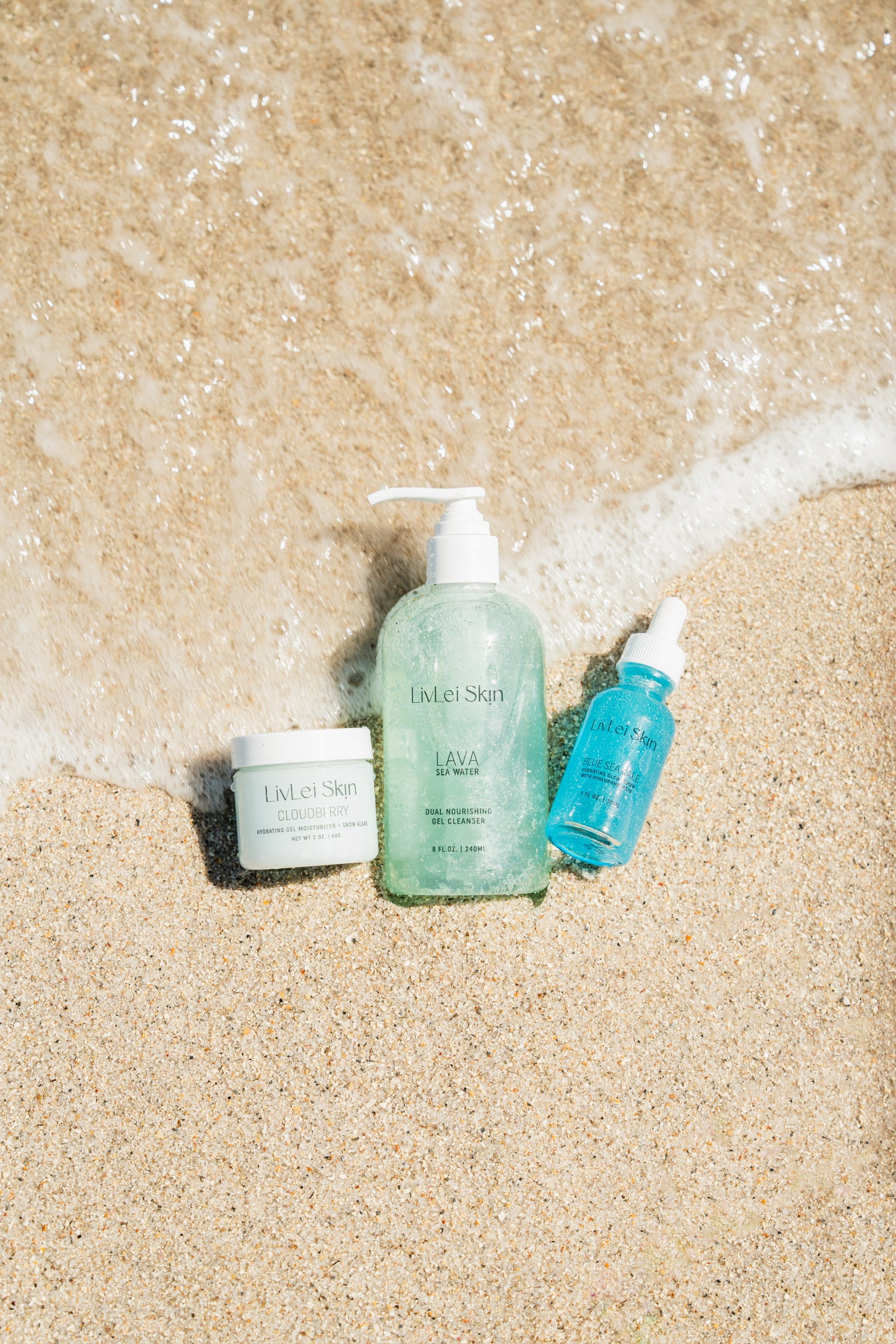
LivLei Skin's Splash Collection was built around exactly this philosophy. It is a complete three-step ocean ritual that covers every function a routine needs — cleanse, treat, seal — using clean, vegan formulas with marine botanical actives at every step.
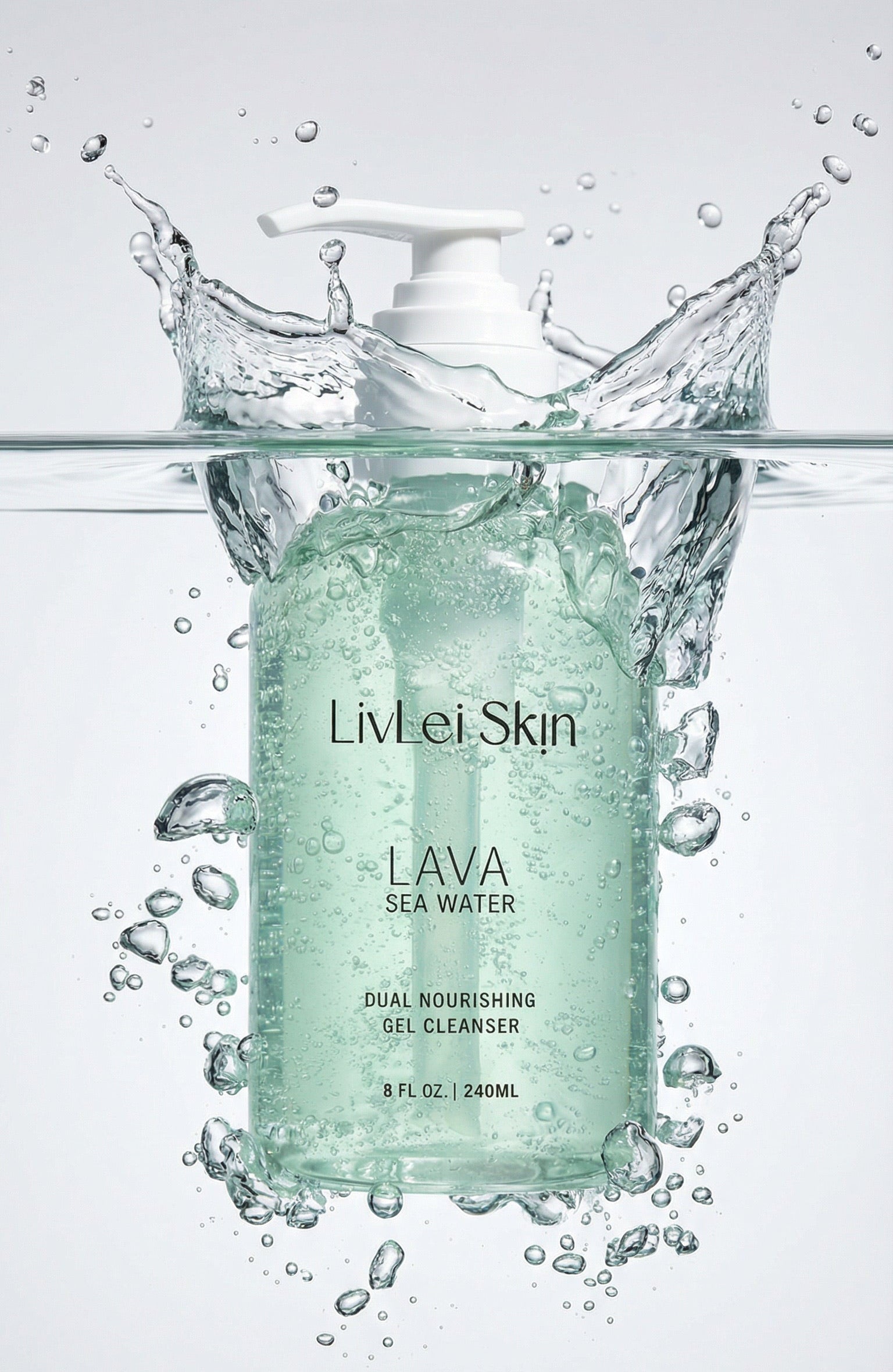
Step 1 — Lava Sea Water Dual Nourishing Gel Cleanser. Applied to dry skin first to dissolve SPF, makeup, and sebum, then activated with water for a gentle lather. The surfactant system uses amino acid-derived cleansers — Sodium Methyl Cocoyl Taurate and Potassium Cocoyl Glycinate — rather than sulfates. The result is thorough cleansing without barrier disruption. Sea water, Spirulina, Undaria, and Laminaria extracts deliver minerals and antioxidants during the cleanse itself. One product, two-phase cleansing action, zero barrier compromise.
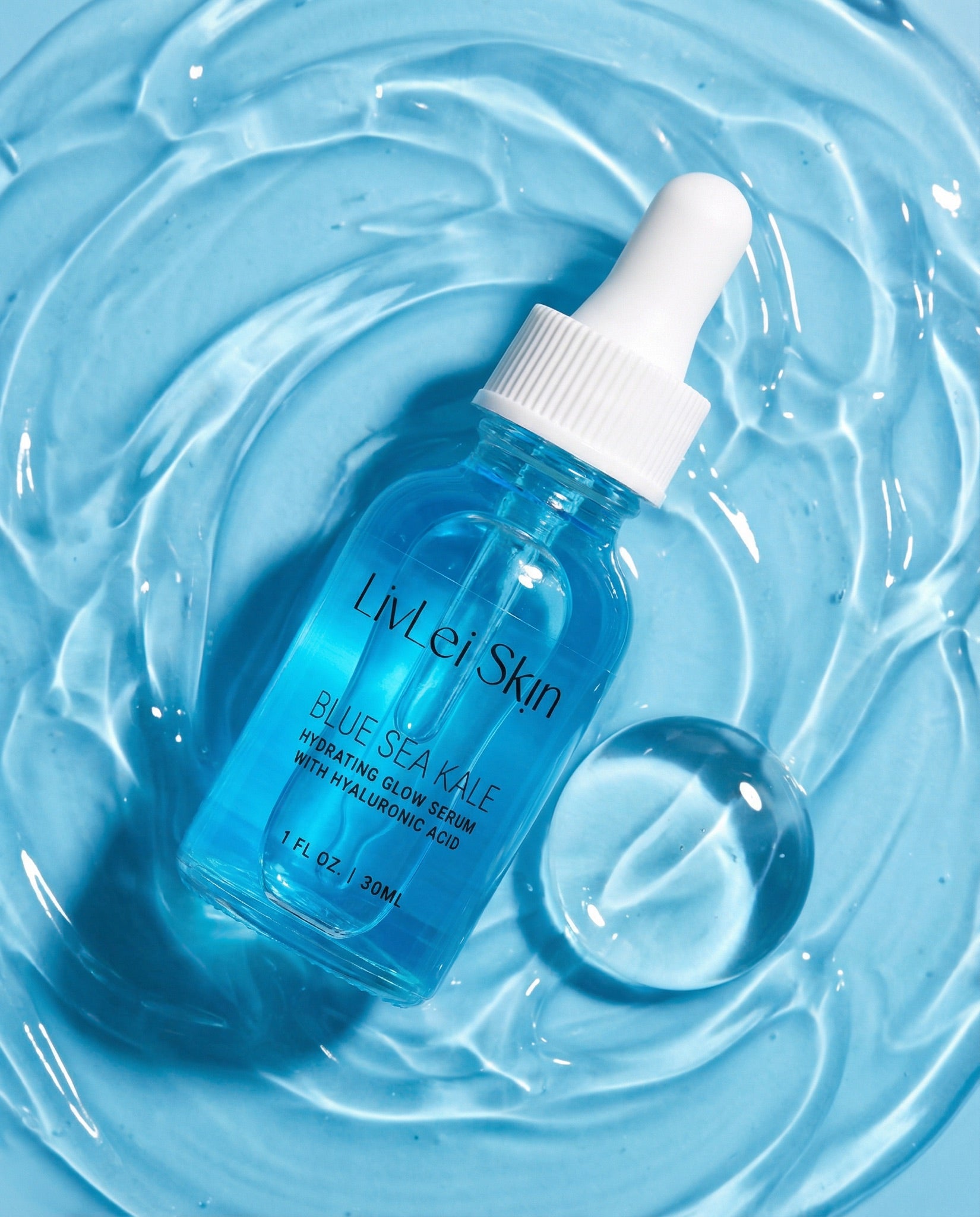
Step 2 — Blue Sea Kale Hydrating Glow Serum. A bi-phase serum that separates into a water-light hydration phase and a nutrient-rich oil phase. Shake before applying. It contains both Hydrolyzed Hyaluronic Acid and Sodium Hyaluronate for surface and deep hydration, Palmitoyl Tripeptide-5 for peptide-driven collagen support, Gardenia Jasminoides Meristem Cell Culture Extract for cellular repair, Crambe Maritima Leaf Extract for barrier strengthening, and Jojoba Seed Oil as the lipid anchor. Three to five drops pressed into slightly damp skin. One product covering hydration, repair, and firming simultaneously.
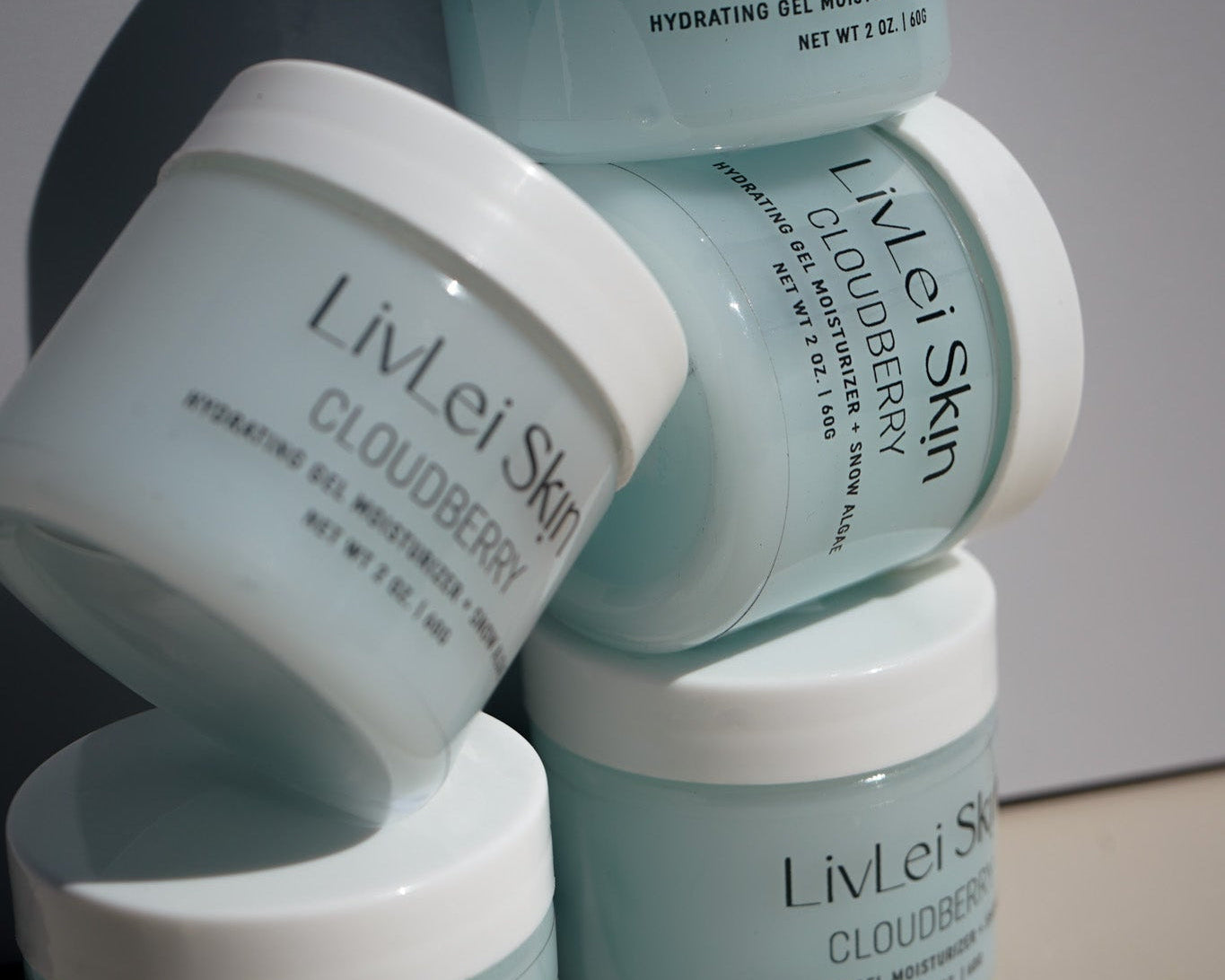
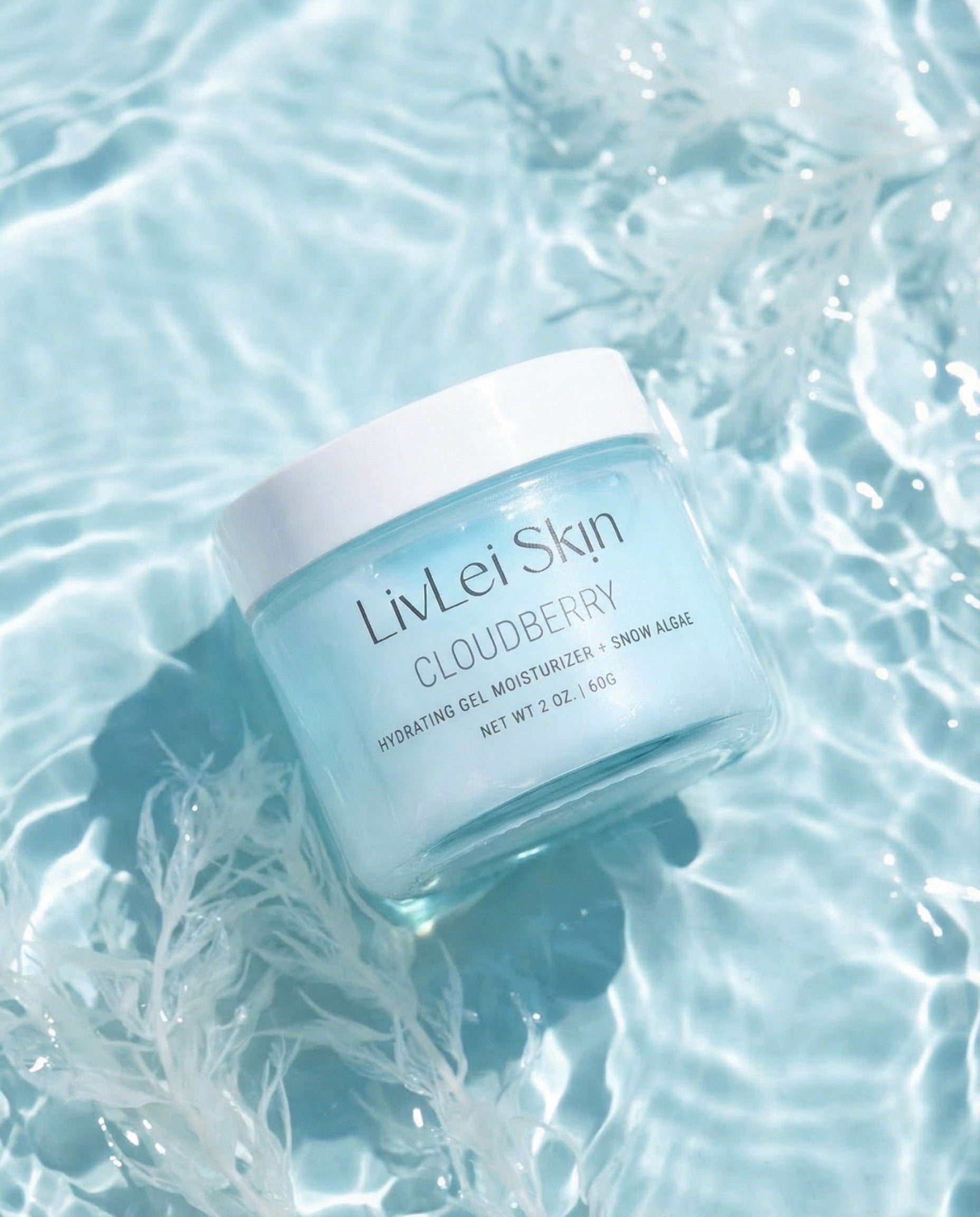
Step 3 — Cloudberry Hydrating Gel Moisturizer. Built around Rubus Chamaemorus (Cloudberry) Fruit Extract, which is exceptionally rich in omega fatty acids and vitamin E for barrier nourishment. Snow algae extract, Aloe Barbadensis Leaf Juice, and Caffeine provide antioxidant protection and de-puffing support. The gel texture seals in hydration without the heaviness of a cream, making it appropriate for all skin types including oily and combination.
Three products. No redundancy. Every step earning its place. Shop the Splash Collection and start your minimalist skincare routine here.
How to Transition to a Minimalist Skincare Routine Without Disrupting Your Skin
Switching from a ten-step routine to three steps is not as simple as stopping everything at once. Your skin has adapted to the products you currently use, and an abrupt change can temporarily trigger purging, dryness, or sensitivity. Here is how to make the transition without disruption:
- Audit before you cut. Write down every product in your current routine and its purpose. Identify where there is overlap, redundancy, or steps that address problems caused by other steps in the same routine.
- Keep your cleanser and moisturizer constant. These two steps are the most disruptive to change simultaneously. Swap one at a time and allow two weeks between changes.
- Introduce your serum last. Once your cleanse-and-moisturize cycle is stable, add your serum. This way you know exactly what is producing any change you observe.
- Give four weeks before evaluating. The skin renews itself on a roughly 28-day cycle. Results from a new minimalist routine will not be fully visible until that cycle completes at least once.
- Resist the urge to add back. If your skin feels stable and hydrated, the urge to layer something extra is habit, not need. Stay with the three steps and let consistency do the work.
FAQs
What is a minimalist skincare routine and who should use one?
A minimalist skincare routine is a three-step approach covering cleanse, serum, and moisturizer — one product per function, chosen for quality rather than quantity. Anyone whose skin is reactive, congested, or simply not responding to a long routine should consider simplifying. A minimalist skincare routine removes the variables that cause ingredient conflict and barrier disruption, allowing the skin to normalize. It is particularly effective for sensitive, combination, and oily skin types that tend to react to over-layering.
How many products does a minimalist skincare routine actually need?
Three products are sufficient for most people: a gentle cleanser, a hydrating serum, and a moisturizer. A fourth product — SPF — is non-negotiable in the morning but does not add complexity to the routine. A minimalist skincare routine succeeds because each product is formulated to cover multiple functions rather than addressing a single narrow concern. One well-chosen serum containing humectants, peptides, and botanical extracts replaces what would otherwise require three to four separate targeted serums.
Will a minimalist skincare routine still address aging concerns?
Yes. The most effective anti-aging ingredients are also the gentlest: peptides, hyaluronic acid, antioxidants, and barrier-supporting plant-derived lipids. A minimalist skincare routine built around these ingredients supports collagen production, reduces transepidermal water loss, and protects against oxidative damage — all of the primary drivers of visible aging — without the irritation risk that comes from aggressive actives. Consistent hydration alone reduces the appearance of fine lines caused by dehydration within two to four weeks.
Can a minimalist skincare routine work for oily or acne-prone skin?
It works especially well. Oily and acne-prone skin is often the result of a compromised barrier that produces excess sebum to compensate for moisture loss. A minimalist skincare routine with a non-stripping cleanser and lightweight hydrating serum addresses that underlying dehydration, which frequently reduces oil production over time. Gel-texture moisturizers provide the sealing step without adding heaviness or comedogenic ingredients. Many people find that clearing their routine down to three steps resolves the congestion that a crowded product lineup was causing.
What makes the LivLei Skin Splash Collection a good minimalist skincare routine?
The Splash Collection covers all three steps of a minimalist skincare routine with one purchase: the Lava Sea Water Cleanser, Blue Sea Kale Serum, and Cloudberry Moisturizer. Every formula is clean, vegan, and built around ocean-derived botanicals that deliver multiple benefits per ingredient. The serum is bi-phase, meaning it delivers both humectant hydration and lipid barrier support simultaneously. The moisturizer uses a gel texture appropriate for all skin types. The system is designed to work together so no additional products are needed to fill functional gaps.
Conclusion
Your skin does not need more. It needs the right three products, applied in the right order, every day without exception. A minimalist skincare routine gives your barrier the consistency it needs to repair, your actives the space they need to work, and you the clarity to know exactly what is delivering results. The Lava Sea Water Cleanser, Blue Sea Kale Serum, and Cloudberry Moisturizer from LivLei Skin are formulated to work as exactly this kind of system. Explore the Splash Collection and build the minimalist skincare routine your skin has been waiting for.